
The power of video search with artificial intelligence
Modern surveillance infrastructure has outpaced the human capacity to use it.
Video surveillance is everywhere. From retail stores to city streets, cameras record tons of footage every day. This constant stream of information presents a big challenge: how to efficiently extract useful information from all this data?
The Scale Problem: Why Traditional Surveillance Is Failing
Modern surveillance infrastructure has outpaced the human capacity to use it. The average mid-size retail chain operates hundreds of cameras. A metropolitan transit authority may manage thousands. Each generates continuous footage - and the vast majority of it is never meaningfully reviewed.
According to IHS Markit research, more than 2.5 billion surveillance cameras are deployed globally, producing an estimated 2,500 petabytes of video data per day. The bottleneck is not hardware - it is the ability to extract actionable intelligence from this torrent of data in time to matter.
The consequences are measurable and significant:
- Retail shrinkage costs U.S. businesses over $112 billion annually (National Retail Federation, 2023), with inadequate surveillance response cited as a contributing factor.
- Law enforcement agencies report that manual video review for a single investigation can require 200–400 person-hours, delaying outcomes by days or weeks.
- Critical security events - theft, unauthorized access, workplace accidents - are frequently identified only after the fact, when timely intervention was still possible.
The core failure of traditional methods is not effort - it is architecture. Human operators reviewing footage are subject to fatigue, attention drift, and the impossibility of watching multiple feeds simultaneously. Basic motion detection generates excessive false positives and lacks the contextual understanding to distinguish a delivery truck from a suspicious vehicle, or a cleaning crew from an intruder.
90% Time Saved Reduction in video review time vs. manual methods in pilot deployments | < 5 sec Search Speed Average time to locate a specific event across a multi-camera system | 60%+ Cost Reduction Decrease in manpower costs for video monitoring and investigation tasks |

From Reactive to Proactive: A Real-World Scenario
Consider a regional retail chain experiencing escalating shoplifting across multiple store locations. Their existing security model - periodic human review of camera footage after incidents are reported - is clearly insufficient.
The Traditional Approach and Its Costs
A security manager receives a report of a theft on a Tuesday afternoon at Store 7. To investigate, the team must manually review footage from six cameras covering the sales floor and exits - approximately four hours of combined recording. Two analysts spend the remainder of the day fast-forwarding through footage, attempting to identify the perpetrator. The result: an incomplete identification, no real-time opportunity for intervention, and a time investment of roughly 16 person-hours.
Multiply this across multiple incidents per week, across multiple locations, and the operational and financial drain becomes unsustainable.
From reactive to proactive security
Imagine a scenario: A retail store experiences a series of shoplifting incidents. Using traditional methods, the security team would have to manually review hours of footage from multiple cameras, hoping to identify the perpetrator.
The AI-Assisted Approach
With VEZHA’s Smart VA module, the same investigation takes a fundamentally different form. When the theft is reported, the investigator opens the search interface and inputs attribute filters: approximate time window, camera zones covering the affected area, clothing description (dark jacket, light-colored bag). Within seconds, VEZHA surfaces the relevant footage clips across all cameras - no manual scrubbing required.
The system’s similarity search then tracks the individual’s movement across the store, building a complete timeline of the incident. Evidence is assembled and exportable in minutes, not hours.
More significantly, VEZHA enables the shift from reactive to proactive posture: the system can be configured to alert security staff in real time when specific behavioral patterns or zone violations are detected - before an incident is complete.
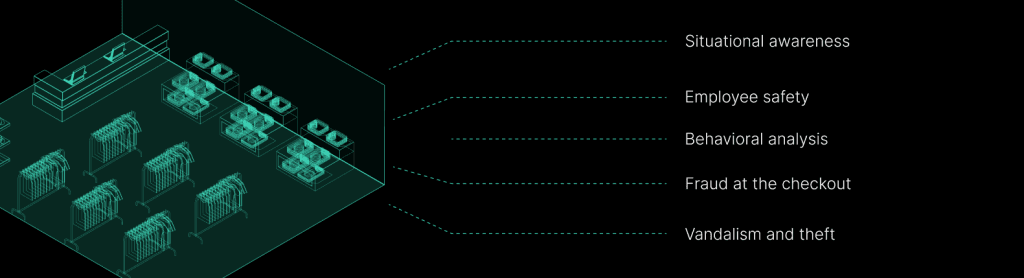
Problem: Shoplifting incidents causing financial losses and security concerns.
Goal: Identify the shoplifter, gather evidence, and prevent future incidents.
Traditional Approach: Manual review of video footage – time-consuming and inefficient.
With Smart VA, they can leverage AI-powered search capabilities to quickly pinpoint the relevant footage. VEZHA Smart VA Module: Utilize smart search to quickly find footage of the suspect based on attributes like clothing, appearance, or the time of the incidents. This would let security teams move from just reacting to security issues to being more proactive.
VEZHA AI Video Analytics: Core Capabilities
VEZHA’s architecture is built on a set of AI-driven capabilities that work in combination to deliver intelligent, context-aware video search across complex, multi-camera environments.
Capability |
What It Delivers |
|---|---|
|
Object Detection & Classification |
Real-time identification of people, vehicles, packages, and custom object classes. Enables precise filtering without requiring manual tagging of footage. |
|
Attribute-Based Search |
Search by clothing color, gender presentation, vehicle type, license plate, and more. Narrows results to relevant footage instantly without reviewing unrelated clips.Search by clothing color, gender presentation, vehicle type, license plate, and more. Narrows results to relevant footage instantly without reviewing unrelated clips. |
|
AI Similarity Search |
Identifies individuals based on visual appearance across cameras and time windows - even without face recognition - using pattern-matching algorithms. |
|
Multi-Camera Search |
Executes simultaneous queries across an entire camera network, constructing timelines and movement paths across locations. |
|
Graphical Zone Filters |
Users define spatial areas of interest - zones, boundary lines, trajectories - to limit searches to specific physical contexts. |
|
Customizable Detection Rules |
Configurable alert logic for specific behaviors, object combinations, or threshold violations tailored to operational requirements. |
|
Preset Filter Libraries |
Saved search configurations allow teams to run recurring queries (e.g., perimeter checks, vehicle monitoring) with a single action. |
Privacy, Compliance, and Responsible AI Use
AI-powered video surveillance operates at the intersection of security and civil liberties - a reality that responsible technology vendors must address directly, not avoid. This is particularly true in markets governed by GDPR, the EU AI Act (which classifies certain surveillance applications as high-risk AI), CCPA, and comparable frameworks worldwide.
Organizations considering VEZHA deployment should assess the following compliance dimensions:
- Data minimization and retention: How long is video data retained, and are automated deletion policies enforced?
- Access controls and audit logs: Who can query the system, and is that access logged for accountability?
- High-risk AI classification: Under the EU AI Act, real-time biometric identification in public spaces carries significant restrictions. Similarity search and person tracking require careful legal review in many jurisdictions.
- Consent and transparency: In employee monitoring and customer-facing environments, notice requirements may apply.
IncoreSoft’s platform supports configurable data governance settings, and deployments should be conducted in consultation with legal and compliance teams familiar with the applicable regulatory environment. The technology is a tool - its lawful and ethical application depends on the organizational policies that govern its use.
Responsible AI surveillance is not a limitation on security capability - it is a requirement for sustainable, legally defensible security operations.
Industry Applications: Who Benefits from AI Video Search
VEZHA’s architecture is sector-agnostic. The underlying AI capabilities apply across a wide range of operational contexts:
Retail & Commercial
Loss prevention teams reduce investigation time and deter repeat incidents through proactive behavioral monitoring. Heat mapping and traffic analytics also provide merchandising and operations value beyond security.
Safe City & Law Enforcement
Multi-camera search and license plate recognition enable rapid suspect identification and movement reconstruction across public infrastructure. Compliance with local biometric data laws is essential in this context.
Industrial & Manufacturing
Hard hat detection, zone intrusion alerts, and behavior monitoring support workplace safety compliance - enabling automated alerts when safety protocols are violated, reducing accident risk and liability.
Education & Campus Security
Perimeter monitoring, anomaly detection, and access zone management provide campuses with real-time situational awareness and rapid incident response capability.
Transportation & Logistics
Vehicle tracking, UIC/container recognition, and traffic flow analytics support operations management and security across rail, port, and transit environments.
Measurable Outcomes for Organizations
The shift from manual surveillance review to AI-assisted analytics produces outcomes that are operational, financial, and strategic:
✓ Operational: Security teams focus on decision-making and response rather than footage review. Investigation workflows compress from days to hours or minutes.
✓ Financial: Reduced manpower requirements for monitoring and investigation translate to direct cost savings. More effective loss prevention reduces shrinkage exposure.
✓ Strategic: Proactive monitoring enables intervention before incidents are complete, shifting the organization’s security posture from documentation to prevention.
✓ Evidential: AI-curated footage clips and movement timelines produce higher-quality evidence packages for law enforcement and legal proceedings.
Evaluating AI Video Analytics: Questions to Ask
Before deploying any AI video analytics platform, security and IT leaders should ask prospective vendors the following:
- What are the system’s accuracy rates for object detection and classification in your specific environment (lighting conditions, camera angles, density)?
- How does the platform handle edge cases - partial occlusion, nighttime footage, crowd conditions?
- What are the data retention policies, and how is footage secured in transit and at rest?
- Is the system certified or compliant with relevant standards (ISO 27001, SOC 2, GDPR data processing agreements)?
- What is the integration path with existing camera infrastructure and VMS platforms?
- What does post-deployment support, training, and SLA coverage look like?
Vendors who cannot answer these questions with specificity should be evaluated cautiously. AI video analytics is a significant infrastructure investment - due diligence on capability claims, integration requirements, and compliance posture is essential.
Conclusion: Intelligent Surveillance as a Strategic Asset
The surveillance footage your organization generates today is a largely untapped resource. The cameras are deployed, the data is flowing - but without AI-powered search and analytics, most of it remains inaccessible at the moment it matters most.
VEZHA AI Video Analytics represents a meaningful advancement in what security infrastructure can actually deliver: search results in seconds rather than hours, behavioral alerts before incidents are complete, and evidence packages that support rapid, defensible outcomes.
The technology is ready. The more important questions are organizational: Are your teams trained to use it? Are your data governance policies prepared for AI-assisted surveillance? Are your compliance obligations understood?
Organizations that approach AI video analytics with both operational ambition and governance discipline will realize the greatest return - in security effectiveness, operational efficiency, and institutional trust.
VEZHA transforms surveillance infrastructure from a passive recording system into an active intelligence asset - but its full value is realized only when deployed responsibly, within a clear governance framework, by teams equipped to act on what it reveals.
Ready to see VEZHA in action?
Request a demo or contact your regional IncoreSoft representative to discuss your deployment requirements. Bring your camera count, environment types, and compliance context - a quality vendor conversation starts with specifics, not generalities.

Dan Vogl
Regional Director Latam
As Regional Director at IncoreSoft, I lead strategic growth and innovation in AI-driven video surveillance solutions across Latin America. My focus is on helping organizations harness the power of intelligent video analytics to enhance safety, operational efficiency, and data-driven decision-making. Passionate about bridging technology and real-world impact, I’m committed to driving smarter, more secure environments through responsible AI.”
Blog
Ready to Get Started?
Fill in the form and our team will get back to you shortly.